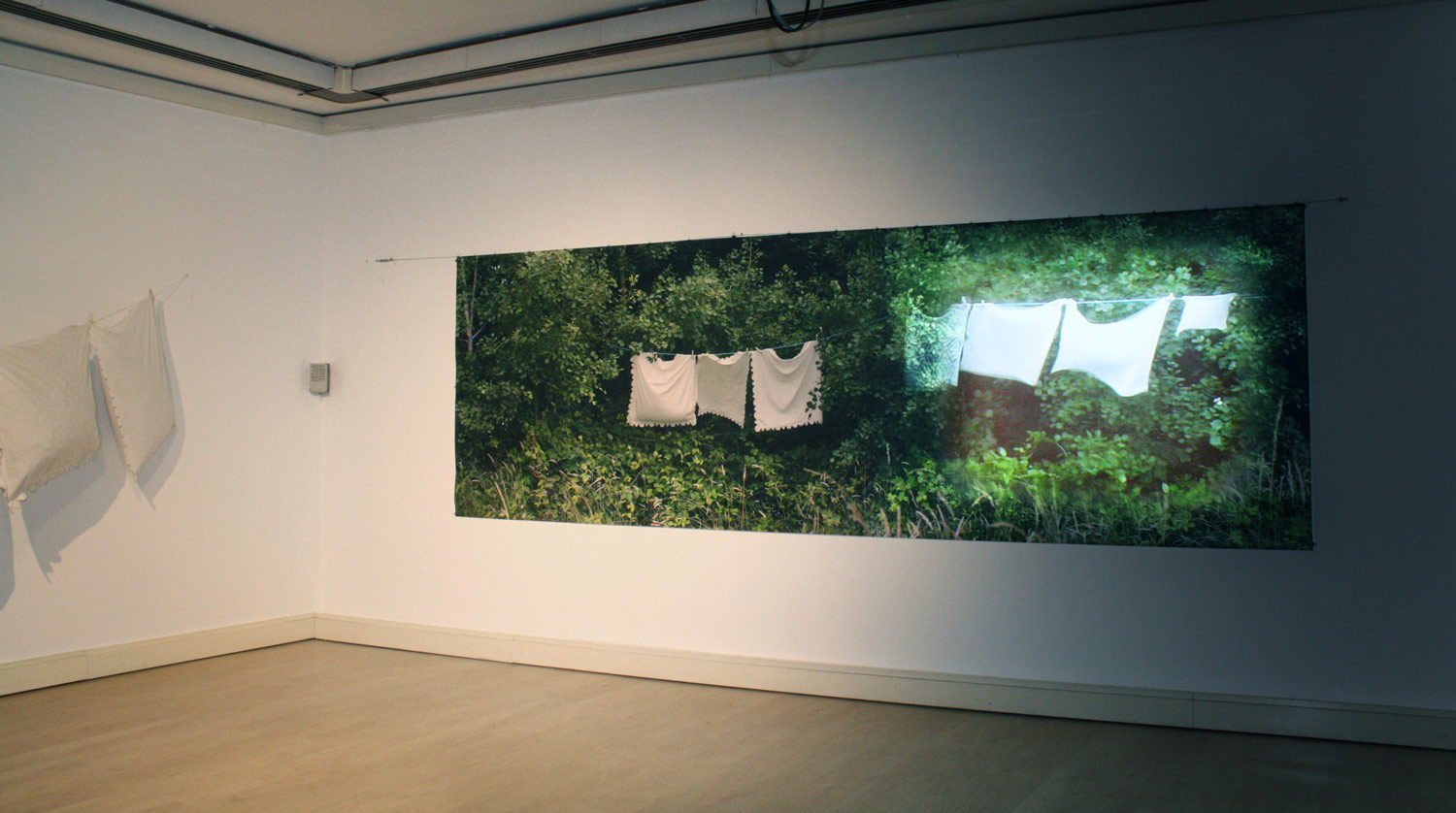
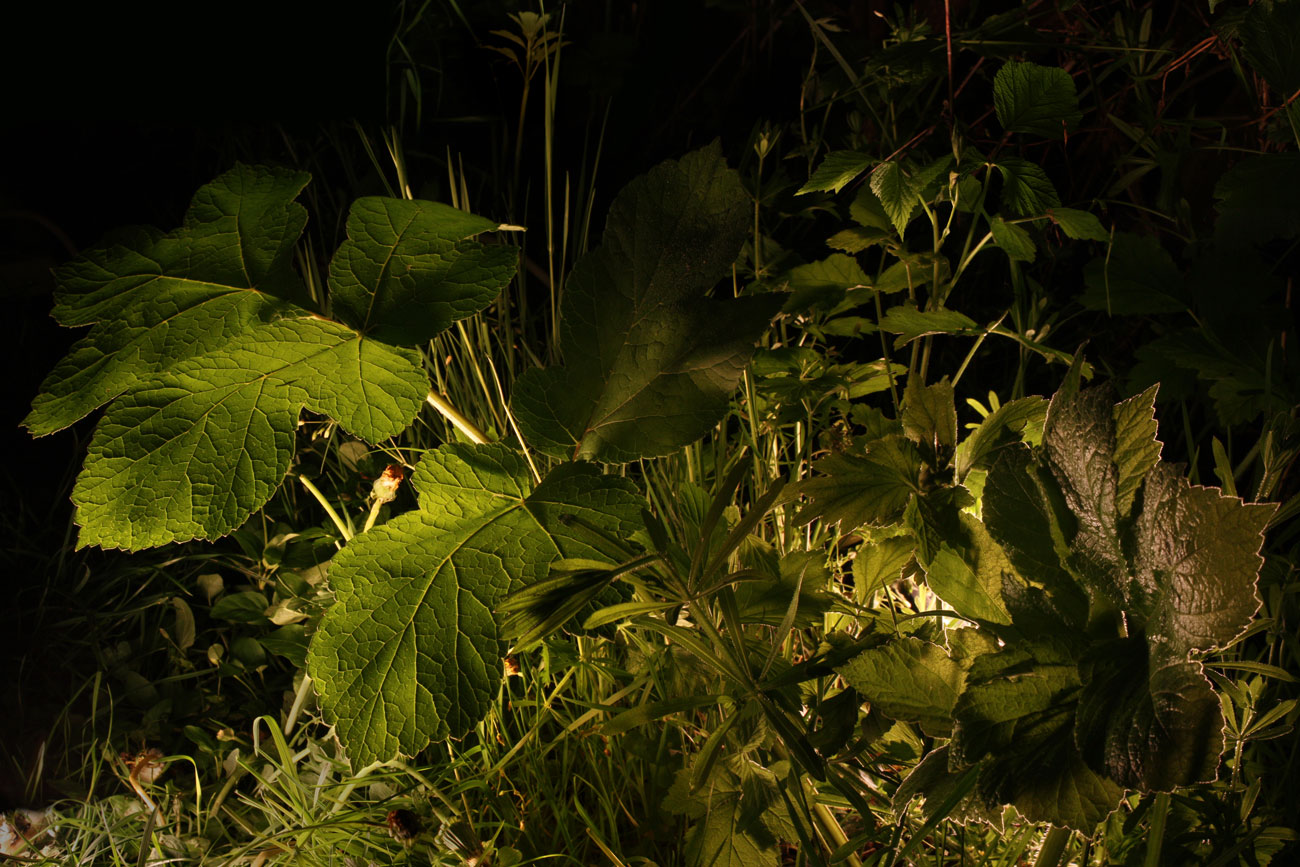
2009 photograph, inkjet print on canvas 350 x 125 cm, video projection, 3′, loop, silent
The landscape of wild vegetation was photographed with an overexposed part where the image is lost in whiteness, a space for an imperceptible blending of the projection of the video recorded in the same place at the same time. In this part, the static of the photo is released into the illusion of movement. The wind that moves the plants corresponds to the human breath, according to the Upanishads: the five internal powers, called breaths after one of them, correspond to the five external deities: sight to the sun, hearing to directions in space, breath to the wind, spirit to the moon, and words to fire. After death they associate with these deities. BAU, III, 2. 13. „Yajñavalkya,“ he asked, “when the voice of a dead man goes into the fire, breath into the wind, sight into the sun, mind into the moon, hearing into the parts of the world, body into the earth, atman into space, hair into herbs, hair into trees, and blood and seed enter the waters, what then remains of a human?“
Calm / Standstill
2008 ambience, photograph, inkjet print on canvas, 450 x 150 cm, projection over the print, 2′, sound, loop 7 pillows with hay and lavender
A large photograph of laundry drying in greenery contains an imperceptibly integrated projection of the same laundry fluttering in the wind. The scent of lavender wafts from the pillowcases, similar to those in the photo and projection, hung on a rope stretched in the exhibition space.
Stara Drava (Old Drava)
2008/2019 photograph, inkjet print on paper, aluminum composite panel 200 x 90, 90 x 90 cm Contemporary Art Collection of the Museum of Fine Arts, Split
Visually, the passage of time is manifested in a kind of “panorama” of different light manifestations in several moments during the day, merged in a unique composition. The basic thought is completed by the quiet flow of the river in the middle ground. At the very edges of the photo, the content disappears into darkness, that is, whiteness.[…] time also has a completely individual dimension: sometimes it seems stretched out like eternity, sometimes condensed and compressed into a moment. (Krpačić, Kornelija. 2015, M.V. / Damir Babić, One on One Cycle, Split: Museum of Fine Arts)
Self-Grown
2006 photograph, inkjet print on paper, 115 x 300 cm, ink on foil 5 x (130 x 90) cm
From a photographed scene of a wild plants community, I’ve singled out individual plants as separate plant personalities. Through the process of drawing enlarged individual plants I explore and learn about the scene seen. The drawings are on transparencies and overlap each other like mental windows through which it is possible to observe the natural world.
Arising
2008 photograph, inkjet print on paper, aluminium composite panel, acryl marker on the polystyrene glass 200 x 100 cm, 4 x (100 x 100 cm) Purchase Award of the Museum of Modern and Contemporary Art Rijeka, 4th Croatian Drawings Triennial, Zagreb, 2008. Art Collection of the Museum of Modern and Contemporary Art, Rijeka
Drawing is thinking, drawing is a way to understand, and photography is direct recording, almost without intermediaries. […] two parallel tracks that are given to us for contact with the world: rational and experiential. (Viculin, Marina. 2012, Swing, Current, Shenanigan, Osijek: Gallery Waldinger)
Colors
2009 photograph, inkjet print on paper, aluminium composite panels 10 x (90 x 60 cm)
By choosing the ubiquitous and everyday motifs of the self-contained world of wild plants and printing them in large formats, the artist speaks of a heightened sense of life, presence, in the language of phenomenology: she enables things to “shine in the purity and thus in the beauty of their unconcealedness”. (Krpačić, Kornelija. 2015, Mirjana Vodopija / Damir Babić, One on One Cycle, Split: Museum of Fine Arts)
Dawn
2008 photograph, inkjet print on paper, aluminium composite panel 175 x 90 cm
The artist gives an almost lofty and monumental dimension to the fragile creatures of plants, and this significant inner tension is often additionally emphasized by choosing a very low point of view from which she captures the scene. The love for details and the sensitive and precise delineation of forms is reflected in the special concern for the deep sharpness of the photograph, the clarity of the outlines in the plans and parts of the composition, encouraging the thought of the wisdom and patience of the building power of nature, devoid of human intervention. (Krpačić, Kornelija. 2015, Mirjana Vodopija / Damir Babić, One on One Cycle, Split: Museum of Fine Arts)
Top, Edge, Detail, Branches, Leaves
2008 photograph, inkjet print on paper aluminium composite panels, aluminium construction, plexiglass 5 x (120 x 60 cm)
Light is the creator and destroyer of the visual: it enables visibility, but its excessive intensity erases parts of the scene. The illusion of the image disappears in the whiteness that opens up space for new contents. Movable panels allow the viewer to select a part of the scene of their choice, to blur it, or use a shiny transparent panel to include their character’s reflection into the scene.
Grass
2008 photograph, inkjet print, aluminium composite panel, aluminium frame, movable transparent plexiglass panels 300 x 60 x 3 cm
Small herbaceous plants were photographed from the close to ground perspective. The photograph is elongated, similar to a film strip along which the viewer can move transparent, shiny or blurred surfaces, thus choosing which frame he wants to highlight. The shiny surfaces, along with the image of the grass, also include a reflection of the observer.